I had wanted to write this much earlier, but like most good intentions, it kept getting postponed by work, travel, and the comforting illusion that tomorrow would be more generous with time. It was not. So here I am, finally putting words to a Sunday that deserves to be remembered.
Sunday, the seventh of December 2025, arrived with bright winter sunshine and a light, honest chill. The kind of weather that quietly convinces you to step out of the house. By late morning, all roads seemed to lean towards the Jawaharlal Nehru Stadium. Inside its familiar concrete embrace, the Sports Authority of India conference room was slowly filling up. And then filling up some more. Many old hands later agreed that this was the largest gathering of Delhi–NCR radio amateurs they had seen in nearly a decade.
Onkar Nath Yadav with fellow radio amateurs at SAI
The crowd itself was a small study in diversity. Engineers stood next to doctors. Students sat beside veterans. Armed forces officers, technocrats, management faculty, homemakers, young enthusiasts, and seasoned operators all shared the same chairs and the same curiosity. Some had travelled from Punjab, Haryana, Uttar Pradesh, and even Hyderabad. A few brought family along, perhaps to show that the voice behind the call sign was indeed human. A quiet celebrity presence added sparkle. Former Asian Games judge Kanan Saha was there, applauded not for medals, but for showing up.
For many of us, voices that had travelled for years through coaxial cables and ionospheric hops suddenly had faces. The experience was mildly surreal. There was too little time to meet everyone properly, but enough to know that such gatherings need to happen far more often.
I have written earlier about this strange intimacy of radio – voices without faces, signals without borders – in a separate reflection, Sirens, Signals & Static Joy
This meet did not appear from thin air. It came together because of two radio amateurs who believed that the Delhi–NCR fraternity needed a common table again. One was Onkar Nath Yadav of the Indian Radio Regulatory Service, until recently Assistant Wireless Adviser at the WPC Wing. Anyone licensed in the last few years will recognise his name and signature instantly. What is less common is that Onkar also holds an amateur licence himself, VU3OOO. That makes him something of a rare species. He is presently on deputation as Director at the Sports Authority of India, which perhaps explains why this meet found its home inside a sporting institution.
The other driving force was Rajani Mohan, VU2HW, fondly known on the air as Hungry Wolf. Rajani has long been a familiar and reassuring presence on Delhi VHF and the 40-metre band at 7.065 MHz. Credit where it is due, he managed to bring together radio amateurs across clubs and affiliations under one roof, something easier discussed than done.
Rajani carries a quiet legacy. His father, the late Madan Mohan Prasad, VU2MMP, was a respected mentor to many. Today, his call sign lives on through the Patna VHF repeater maintained by the Society of Radio Amateurs (SORA). Some stories in amateur radio refuse to end, and that is a good thing.
My own introduction to this meet was anything but straightforward. Three days before the event, M. S. Kamat, VU3SLJ, called and requested that I attend. Soon after, a WhatsApp invite followed. It looked neat enough. Venue, date, time, and two call signs listed as hosts. One of them read VU2OOO. Curiosity got the better of me. A quick visit to QRZ revealed that VU2OOO belonged to Rani Gupta of Guna, Madhya Pradesh, spouse of the veteran R. D. Gupta, VU200. This raised several questions. Why was VU2OOO hosting a Delhi meet, and why was VU200 himself not coming? I let the thought rest, slightly puzzled.
Later that evening, I posted a photograph of my VX-6R handheld in a small WhatsApp group, accompanied by a hopeful line about the World Trade Tower repeater returning to life someday. The response from Rajani was instant. Was I joining on Sunday to raise my voice for the repeater? That single line clarified what the invite did not. The meet was about a repeater, or more precisely, the absence of one. Since the decommissioning of the VU2DLR repeater and the closure of Vigyan Prasar, Delhi–NCR operators have been operating at a noticeable disadvantage.
The final piece of the puzzle fell into place only at the venue. The mysterious VU2OOO turned out to be nothing more than a printer’s devil at work. The invite had meant VU3OOO, Onkar’s call sign. One missing digit had managed to generate an evening of speculation and a good deal of laughter later.
The invite that sparked an amusing confusion
When an Indian Radio Regulatory Service officer meets radio amateurs, conversations do spark and ideas do fly. Onkar’s presentation was delivered in Hindi, but the message translated effortlessly. Sports connect people. Ham radio can also become a sport. Radio sport can be adventurous, competitive, and engaging. If made interesting, students of science will take part willingly. When it gains visibility, leaders will notice. Radio sport, he suggested, is worth investing in.
Ham radio, after all, is one of the earliest forms of social media, long before the term became fashionable. It accommodates a surprising range of interests. Homebrew rigs and antennas sit comfortably alongside satellite communication, space station contacts, long distance DX chasing, contesting, digital modes, and long evening conversations that wander without apology. For a newcomer, it is a technical playground. For a veteran, it is a lifelong companion.
Every participant at the meet was invited to introduce themselves. Each story had its own rhythm, but one stood out sharply. Colonel Nasser Hussain Dubey, VU2DUB, formerly of the Ninth Parachute Field Regiment, an elite formation of the Indian Army specialising in counter terrorism, spoke with calm clarity. During his service in Jammu and Kashmir between 1991 and 1996, his unit tracked insurgent VHF transmissions using little more than directional antennas, maps, and a compass. Signals were intercepted, bearings taken, and local assistance used to translate languages. The collected intelligence was then passed to the Wireless Monitoring Organisation and onward to operational units.
Col. Nasser Hussain Dubey, VU2DUB, sharing field experience
Between 1996 and 2000, posted in the northeast and based in Aizawl, he formally set up his amateur HF station. He often monitored the 20-metre band, spanning 14.000 to 14.350 MHz, where cross-border transmissions from deep forested regions bordering Indo–Myanmar, including the Kachin region, and from across the Bangladesh frontier occasionally surfaced. Recorded tapes and supporting dossiers were forwarded to the Wireless Monitoring Organisation, which has a permanent presence in Shillong. Using signal direction, experience, and field intelligence, teams navigated dense forests, hills, and difficult terrain, sometimes coming close to high-value targets. There was no internet then, no satellite navigation. It was, in essence, fox hunting at a professional level.
When Sandeep Baruah, VU2MUE, spoke, the room leaned forward. Formerly Scientist F at Vigyan Prasar, now closed by administrative decision, he raised a pointed but measured question. What was the present status of the VU2DLR repeater hardware and associated equipment handed over to the Wireless Monitoring Training and Development Centre (WMTDC) in July 2024? His remarks aligned neatly with the question that had been quietly circulating all morning.
Sandeep Baruah, a maverick scientist and adventurer whose curiosity knows no bounds, was the custodian of Delhi’s oldest repeater, VU2DLR, and its associated equipment for more than two decades. Under his watch, Delhi VHF rarely fell silent. Many will remember checking into the nightly net, followed by extended conversations that stretched well past reasonable dinner times. Winter ducting often brought stations from Punjab, Haryana, and Uttar Pradesh into the repeater late at night and early morning. Those were warm frequencies in every sense.
According to sources familiar with the matter, the factual trail is laid out clearly. With the closure of Vigyan Prasar, licences were surrendered and equipment transferred as per rules to WMTDC under the Ministry of Communications. The hardware, including repeaters, transceivers, and accessories, remains functional. Some items are barely used. The question now is not about ownership, but about intent and utilisation.
The larger story of Delhi-NCR’s silent repeater and the hopes once pinned on the World Trade Tower has been documented earlier in my post, Delhi-NCR Repeater: Hopes from a Tower
It is widely speculated that Onkar, presently at SAI, may be in a position to take this forward more formally when he returns to his parent department with higher responsibility. Whether that happens remains to be seen, but the possibility has given many operators cautious optimism.
Bhanu, VU2MB, bringing flair to the gathering
The meet had its lighter moments too. Bhanu P. Singh, VU2MB, arrived with effortless flair, dark blazer, cowboy hat, and an illuminated name badge, before departing quietly in a sleek electric vehicle. Kaustav, VU2UUU, drew attention with a lightweight homebrew telescopic dipole mounted on a modest tripod. Simple in appearance, adaptable in design, it reflected his broader approach to amateur radio. From satellite work to low power VHF contacts across states, from clever digital mode hacks to broadcast quality audio from minimalist circuits, his enthusiasm is infectious.
As the afternoon wound down, there was general agreement that such gatherings should be held at least once every three months. Many operators had not known about this meet at all. Better communication will be essential going forward.
Delhi-NCR radio amateurs at Jawaharlal Nehru Stadium
The hope, unspoken yet shared, is that valuable equipment does not gather dust in storage rooms. Delhi–NCR needs an effective repeater, much like the one deployed during the October 2025 mock drill at the World Trade Tower. The pieces exist. The people exist. The energy certainly exists.
The signal is waiting. It would be a shame not to transmit.
All my regular work collapsed the moment I saw that Department of Telecommunication Office Memorandum. It landed like a brick on my desk two weeks ago. I had my deadlines set, my plans neat and clear, but this notice pulled the plug. Suddenly my life was not about writing or work, but about surviving the Saral Sanchar portal.
The memorandum, dated 11 March 2025, ordered all licensed ham operators to migrate their certificates to this sparkling new online system before 15 September 2025. A clean digital push, they said. In reality, it was like asking us to wade through a swamp with leeches tied to our legs.
I saw the circular in a WhatsApp ham group. Oddly enough, the discussions there were muted. Maybe people were already too tired to rant.
Ham radio is no joke. It has been a lifeline in floods, quakes, cyclones. When phones die and networks collapse, ham operators keep authorities connected. No money, no perks. Pure service. And now, the very community that serves in crisis is itself in crisis, thanks to a half-baked portal.
I logged in. Made an account. Took a quick glance at the migration tab. It looked like a puzzle dumped on a child. I still tried. Failed. Then flagged my frustration to fellow hams. Messages poured in. Some confused, some angry, some downright hilarious. “Why migrate at all?” one asked. “It’s tedious, I won't migrate,” groaned another. Someone said they managed to upload but were told to resubmit. Another gem: “Only Aadhaar needs attestation by a gazetted officer.”
Then came the manuals. One was 20 pages, the other 39. So apparently, to move my licence from one digital shelf to another, I must first pass an exam in patience and eyesight.
It wasn’t just me. Many were shaken, stuck, lost. Some tried helping others through remote screen-sharing. Some behaved like self-appointed WPC officers, flaunting their “cheat sheets” on WhatsApp. They were helpful until arrogance starts. A comedy show, but with more tears than laughs.
I reached out to the help desk. Their replies were slower than snail mail. And useless. Templates copied and pasted. Nothing addressed my problem. The portal itself was clunky, cryptic, allergic to common sense. No tooltips, no guidance, just endless trial and error. At one point, I begged them to delete my account so I could restart.
And then came the monster called attestation. Out of nowhere, hams were told to run behind gazetted officers to stamp Aadhaar cards. When the government itself says self-attestation is fine, why this madness? Why drag us back to the days of stamps and seals? To prove we exist, again and again?
Anyone who has tried approaching a gazetted officer knows the drill. Excuses, delays, smirks. I even recalled an old story. Years ago, when MTNL asked for attested IDs, I approached my uncle, a senior government officer. His reply? “How do I know you’re not a criminal?” I shot back: “I didn’t come for a character certificate. Your job is to match photocopy with the original and sign.” He finally did, after the drama. That’s what attestation culture looks like. Power, not purpose.
Meanwhile, other government services are years ahead. When I renewed my driving licence in Delhi, Aadhaar OTP was enough. Fast, simple, painless. Yet for ham radio migration, we are forced to perform clerical duties that WPC staff should be doing.
Office Memorandum: Typically meant for internal govt communication, not public dissemination. Yet, used here to coerce compliance via WhatsApp groups.
There’s also the strange legal twist. The 11 March 2025 note was an Office Memorandum, meant as an internal instruction. Not even a circular for public circulation. Yet hams are being coerced into compliance. And not a single direct email or SMS to licence holders, even though WPC has our details. Instead, whispers in WhatsApp groups. A mess created out of thin air.
At one point, I almost thought of quitting amateur radio altogether. The frustration was that heavy. A hobby rooted in freedom and service is now buried under paperwork, passwords, and pointless hurdles.
Saral Sanchar was supposed to make life easier. It has only made life smaller. A portal where time dies, humour struggles to stay alive, and passion for radio drowns in bureaucracy.
I’ll keep documenting this circus. Maybe one day someone in power will read, laugh nervously, and fix it. Until then, migration feels less like a system update and more like punishment for being a ham in India.
India's Landmark Moon Landing Sheds Light in Grief!
Discover the awe-inspiring journey of India's Chandrayaan 3 moon landing, an extraordinary feat that made history. Explore the unique fusion of space exploration and art, with Pink Floyd's iconic album cover as a backdrop. Delve into the significance of this achievement and its impact on space enthusiasts and amateur radio operators.
The recent historic soft landing of Chandrayaan 3 on the Moon has stirred up a spectrum of emotions, casting a momentary eclipse over my personal grieving. Amidst the shadows of sorrow following two family losses in the span of just three months, the monumental achievement by India through the Indian Space Research Organisation (ISRO) has managed to illuminate our hearts.
India etched its name in the annals of history on August 23, 2023, when the Vikram lander, carrying the Pragyan rover, gracefully descended onto the lunar surface. This
Harmony of Worlds: Moon Landing Meets Music Icon
exceptional feat not only positioned India as the fourth country to accomplish such a landing, following the footsteps of the USA, Russia, and China, but it also secured India's place as the pioneer to touch down near the Moon's enigmatic south pole.
As news of this remarkable milestone spread like wildfire, the skies echoed with the crackling of celebratory fireworks, painting the neighbourhood in vibrant hues of the tricolour. Social media platforms buzzed with heartfelt congratulatory messages and artistic graffiti, capturing the essence of India's achievement and ISRO's success.
The words of ISRO chairman S Somnath echoed with triumph: "The rover movement is working very well." He further shared that the lander landed flawlessly at the designated site, a pinpoint location within the marked coordinates. With a deviation of just 300 metres from the intended point, it demonstrated remarkable precision and skill.
India is on the Moon
In a lighthearted twist, one could jest that ISRO's inspiration for this lunar endeavour might have been drawn from the iconic album "The Dark Side of the Moon" by the legendary British psychedelic rock band Pink Floyd. Although purely coincidental, the analogy invokes a whimsical connection between the Moon's enigmatic south pole and the album's captivating mysteries. Certainly, this analogy will surely amuse the band members - lead guitarist Syd Barrett, bassist Roger Waters, drummer Nick Mason, keyboard player Rick Wright, and Vocalist-guitarist David Gilmour.
The term "dark side of the Moon" has often been misconstrued to mean absence of light, when in fact it signifies the Moon's unexplored realms, shrouded in mystery. Much like the album, each hemisphere of the Moon experiences alternating cycles of light and darkness, akin to the ebb and flow of life's experiences. For ham radio enthusiasts, this monumental event heralded a unique opportunity. The Ministry
Connecting World: Pune Hams in Action
of Communications, Department of Telecommunications, Wireless Planning and Coordination Wing, New Delhi, issued a special callsign "3CY" for Chandrayaan 3. This distinctive call sign was appended to authorised callsigns from August 23 to August 30, 2023, adding a touch of lunar legacy to radio waves.
As per its circular with reference number P-14011/01/2021-COP, dated 23-08-2023, the Ministry conveyed that eligible holders of Amateur Wireless Station licenses are allowed to append '3CY' to their authorized callsigns during the period from 23-08-2023 to 30-08-2023. Furthermore, the digital landscape came alive with special callsigns such as AT2ISRO, AT3MOON, AT3CYN, and AT3MON, announced by DoT India on platforms like X- formerly
LVM 3 Rocket
Twitter, signifying the global celebration of the Chandrayaan 3 mission.
Amateur Radio call signs are assigned to Ham operators worldwide for identification purposes. These call signs distinguish station operators. Call signs function like unique names in the Amateur Radio community, serving as a global recognition method for operators.
Ham radio enthusiasts worldwide, whether through HF, VHF, UHF, digital modes, satellites, or the rhythmic Morse Code, have united in celebrating this achievement. Through the wavelengths of the radio spectrum, their camaraderie and jubilation resonate, embodying the spirit of discovery that unites us all.
As we navigate through our individual journeys, the luminous achievements of Chandrayaan 3 serve as a testament to human ingenuity, casting a hopeful light on even the darkest moments.
Amateur Radio Unites: Celebrating Chandrayaan's Triumph
Video Description:
Join the global community of amateur radio operators as they celebrate India's historic Chandrayaan 3 moon landing! From worldwide pileups to unity in special callsigns, ham radio enthusiasts come together to honor this remarkable achievement. Watch as operators connect across distances, from the Western Ghats to Nepal, sharing the excitement of Chandrayaan's success. Amateur radio, a bridge across borders, keeps the spirit of exploration alive. Stay tuned for more ham radio moments and discoveries.
Click or Tap to Follow/SubscribeTimesViewBlogspot.Com
It was festival of lights and the cool evening of Bangalore was glittering amid the
quiet ambience of a nationwide COVID-19 lockdown. I had been air-dashed to the silicone city nearly a couple of months ago for a medical treatment following a horrendous accident at New Delhi. Observing the cityscape from my terrace, the evening hours were no different from the other metropolitan cities and towns with shutters down and deserted streets.
There were intermittent Diwali greetings phone calls and WhatsApp messages piled up in my mobile which I decided to check them only once I hit the bed. One of the messages congratulating me set my day. It was from a Gurgaon based senior Ham Radio Operator, VU2CW alias, Rajesh Chandwani. He had procured my licence from the Wireless Planning & Coordination Wing, Ministry of Communication, Government of India, New Delhi and sent it to my WhatsApp.Photo: Diwaliat Bangalore
Next day the first thing I did was to get through the drills of being registered in the Echolink platform. Once I was through, opened the App in my mobile, went to the settings and typed “Listening mode” in the name field. The reason behind doing this was to get a fair taste of the various Nets around the world before finally deciding to check-in to the Nets of my choice since some of them conducts in their respective local language which I try best to avoid. Globally, English is considered the universal language of communication in Ham Radio or Amateur Radio and hence, the popular phrase - “One World, One Langauge”. Incidently, Echolink does not provide the listening mode option, though.
Earlier on 30th October 2020, in a unique way monitored the Delhi local VHF Net live on the VU2DLR repeater faraway from my Bangalore QTH (residence of a Ham) that appeared to have spiked up all my good hormones - serotonin, dopamine, endorphins and oxytocin. Was pretty down due to the fatal wound in my right hand which has left me crippled, but a sudden video call that integrated live audio feed of the Delhi VHF Net, chased away that gloomy mindset.
Blending airwaves with the cyber highway was just like a fusion indeed. Unlike the technologically advanced VU2FUN and VU2HUB Delhi repeaters which are privately owned by two enterprising brothers - Karan Bakshi (VU2IB) and Rajesh Bakshi (VU3FUN), VU2DLR repeater is not patched to the Echolink platform. The ingenuity of Pradeep (VU2AK) of pulling me into the Delhi Net was much appreciated. I remember the kind words of encouragement for getting well soon poured in from senior Hams like Kamath (VU3SLJ), Net Controller of that day, Sandeep (VU2MUE) including several other Hams.
For a short while the Net signals went down and so the audio quality too deteriorated resulting in latency. Some of the callsigns which had exceptional audio quality were VU2CW, VU2FR, VU2LO, VU2BQF, and VU2NW. It was even interesting taking me for a virtual tour to VU2AK’s shack which had some homebrew rigs among others.
On 17 December 2020, I took the afternoon flight from Kempgowda International Airport (KIA), Bangalore and had returned to New Delhi for a week. Figured out the frequencies and then programmed my radios to the local repeaters. Honestly, it was like reviving my old hobby but, now legally and no more in a hush, hush manner playing with transceivers and antennas which I used to do during my school and university days.
On a chilly Christmas eve was my maiden appearance in the Delhi VU2DLR repeater when I had gone live on air in the VHF Net. VU2MUE, handle, Sandeep was the net control station on that day. Pushing a mere four watts of power with my handheld radio and the stock rubber ducky enabled all Hams tuned in to the frequency to copy my signals fairly loud and clear.
Next evening, 25 December 2020 on Christmas day, I flew to the City of Joy. At the Indira Gandhi International (IGI) Airport I got a bit worried about my cabin luggage since I was carrying my two little radios, cameras, power bank, including few other electronic items. Just like any other passengers in the queue, I had also picked up a tray and placed my hand luggage in it for the automated roller rails to take it through the scanner for security check. Photo: Christmas carol singers inside IGIA, New Delhi
Meanwhile, I was already physically frisked and was waiting for my hand luggage at
the other end. Suddenly, I noticed the scanner’s light change from green to red and my tray was subsequently moved to an adjoining track roller rail for a physical check. There were few other trays before mine and I was watching them slowly approaching one after the other for a thorough check by the Central Industrial Security Force (CISF) personnel.
Passengers who were carrying larger than permissible size of liquids and perfumes, chemicals, lighter, matchbox, greasy bottled eateries such as pickles, pen knifes, sharp objects, etc were summarily confiscated, while many were reprimanded too. All this while I had been keenly watching others that gave jitters and remotely made me feel like a miscreant for no reason. Photo:St Paul's Cathedral, Kolkata
Finally, when my turn came, a CISF officer pointing objects at his computer screen
which reflected images from inside my cabin luggage, asked me what was it and to take it out. I took out my electric beard trimmer, the transceivers and along with it flaunted my Amateur Radio Licence. The CISF personnel after quickly examining the licence which had the prominent insignia of government of India, immediately responded with a courtesy saying, “Sir if this (licence) had been shown earlier then you would not been held so long, apologies…” I told myself COVID rules anyways makes it mandatory for passengers to check in two hours before flight schedule and I had enough time to loiter or relax at the airport lounge. Photo:View from inside the aircraft while midair
After landing in Kolkata, pulled out the two little handies. One of them was put on scan mode while on the other I punched in frequencies of the local repeaters. It was fun checking in to the regular VHF Nets on the repeater as well as making QSOs (communication bewteen Hams) on Simplex mode that sometimes led to interesting ragchew (discussion between Hams over the air). It was nice to check in to the two Kolkata Nets run by WBRC (West Bengal Radio Club) and BARS (Bengal Amateur Radio Society). Photo:The picturesque Ganges River in Kolkata
Some of the familiar Hams who used to conduct the regular Nets on the WBRC repeater were Saurav (VU3JXF), Sangita (VU3ZIH), Soham (VU3WNJ), Ambarish (VU2JFA) and Kawsar (S21SKV) who operates from Dinajpur in Bangladesh.
Here something unique which I had noticed was that the BARS repeater which had
turned faulty since long ago, did not dither it’s regular VHF Net as it was being carried on in Simplex mode at 145.200 MHz daily from 10:00 PM to 10:30 PM. I remember coming across Ashish (VU2GMT), one of the Net Control Station and few others whose callsigns I do not remember.
During my short span in this city that was decked up with Christmas and New Year decors, I had done several experiments with regards to range tests which was very enriching. This exercise also helped me in building new Ham friends over the airwaves and I assured to visit them in my future visit to the City of Joy. Photo: Park Street, Kolkata
After spending a little over a week in Kolkata, next I flew to the Garden City on 3rd
January 2021. While I was racing to the Netaji Subhas Chandra Bose International Airport (NSCBIA), Kolkata to board steel wheels, back in my mind I was again apprehensive about the security check of my cabin luggage as I was carrying my handies besides, other electronic items. However, it was a breather indeed - security check here at the NSCBI Airport sailed off without any hindrance.
On landing at the Kempgowda International Airport (KIA), Bangalore in the evening, I pulled out my two radios again and set them on scanning mode. Was simply delighted to discover that the radios triggered all the repeaters and were roaring with strong signals. Photo: An aero bridge at IGIA, New Delhi
Two VHF Nets were underway while I was alternatively monitoring both the stations. After listening for a while, I pressed the PTT (press to talk) button and first checked in to the Indian Institute of Ham repeater. Dr. Sathyapal, VU2FI was the Net Control Station who had accorded a warm welcome into the Silicone Net.
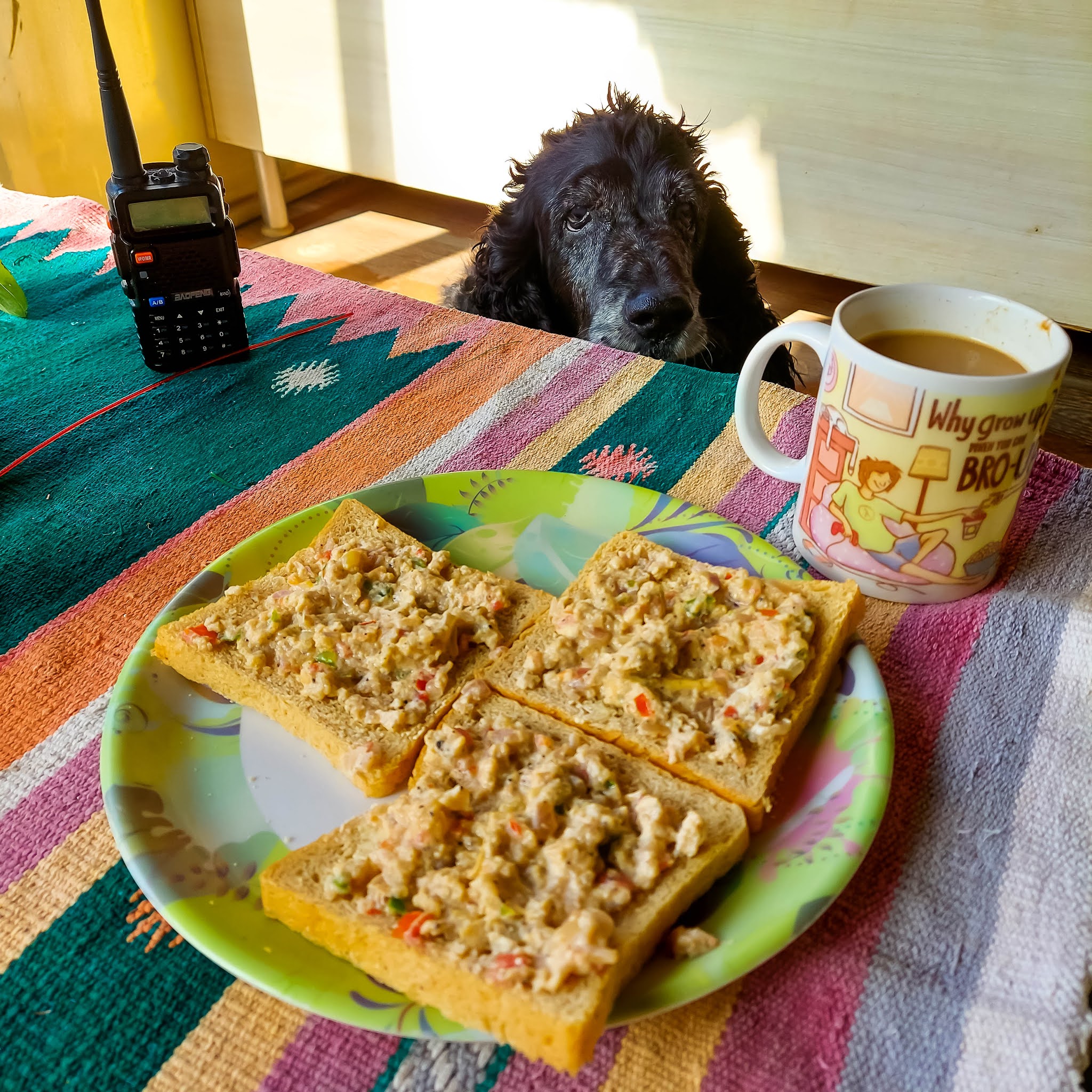
This was followed by checking into the QNY Memorial Net. Net Control Station, VU2YVK, who is affectionately addressed as Vijayda, had some real kind words for my maiden appearance in the R-3 repeater. He had also briefed me about the timings of other daily morning Nets and requested to check in for the same as well as the R5 repeater. Photo: Bailey, the eleven years old black English Cocker Spaniel always by my side
Interestingly, several VHF Nets running in a day as well as QSOs on Simplex mode and the abilities of my cheap little radios to trigger all repeaters including several Simplex signals from my Bangalore QTH made me feel them as precious as just like any owners of the premium Kenwood TH -D74 or Yaseu FT-3DR are to them.
I started regularly checking all the Nets and the best part was that within a short time
my callsign had got pretty familiar with all the Net Control Stations since it had become evident as most Hams immediately recognised it’s handle. Sometimes the quick radio check often led to long QSO roundtable ragchew reinforcing the bond and trust between each Ham operators. At times when several breakers (Hams who join the discussion midway) join into the discussion many jumble up the callsigns too and try to correct it in the subsequent overs. It was fun though yet maintaining the protocols.
On 7th January 2021 at 145.650 MHz, -600, R3 morning Net, it was a pleasure listening to Vijayda (VU2YVK) with his unique intonation and dexterity he conducts the programme. This repeater which is not patched to the Echolink platform still manages to get a whopping 50 - 60 plus check in through direct RF (Radio Frequency). He was able to copy me 5 & 7 direct while 5 & 9 plus through the repeater. All I was using is my tiny handy with the stock rubber duckies which had been doing a fine job for me. The bottom line is I cannot trash these handies and become a rig snob. There is so much of learning from these tiny HTs which has quickly helped me to come on air live while hopping cities.
The garden city caused ripples around the world on January 2021. First, an all women crew Air India made its maiden flight from San Francisco to Bangalore. Next, on 14 January 2021 it was the all women Net Control Stations from Bangalore to conduct a special VHF Net on the IIH repeater (145.800 MHz, -600) which is also patched up with the Echolink to facilitate Hams across the world to check-in. The Net Control Station (NCS) team comprised of Nisha (VU2NIS), Bhoomika (VU3JYP) Sowmya (VU3SIM) and Smriti (VU3FNV) who were excellent that saw more than 180 plus check in.Photo:The all women NCS (Photo, Courtesy: VU2FI)
January also witnessed significant favourable propagation in different regions of South India enabling distant stations to trigger the Bangalore repeaters and check in to the regular VHF Nets. The much blessed Sporadic-E or ‘Es’ in short, saw Hams waking up the Bangalore repeaters as far as from Kanyakumari, Calicut, Salem, Hyderabad including few Dx stations from Southwest India too. One of the many familiar Hams was an ENT physician, Dr T A Thangavelu who used to regularly trigger the Bangalore and other southern states repeaters from his QTH at Erode, Tamil Nadu.
Checking all the Nets on the repeaters, Simplex mode QSOs and range test et al,
suddenly got me an invitation to take part in the VU Bangalore Ham Contest. And yes, I had sportingly taken part although with my dual band handies. Finally, the two-day Bangalore VU mega contest in the VHF, UHF and 6-meters bands concluded on 17 January 2021 at 12:59 hrs with lot of fan fare and learnings, but with a different kind of a ‘pleasant stress'.
What I could guess is there were hundreds of contestants turning the different spectrum bands into a foxhunt to trace Hams over the airwaves. The organisers under the leadership of Vijay (VU2YVK), Exo (VU2EXO) and Prathap (VU2POP) among others, did an excellent job by giving a fillip to this world’s oldest form of social media alias, our amazing hobby - Ham Radio. Photo: Part of my Contest set up in the terrace
Working stations with my handies on the stock rubber ducky frequently forced me to move around to find sweet spots for different stations to be heard and received. Often I had to run to and fro between my call log sheets and sweet spots making it quite tiring at times, though.
The handies were literally being put on heavy duty that resulted in getting them almost fried up. A Ham with a great sense of humour advised to quickly make an omelette on it or else the radio’s circuitry will burnout, while another commented if my grid square location was at a freezing area then my hands could act as a good heat-sink.
With my poor little radios I was able to work around twenty stations until the juice of my rig completely drained off and wouldn’t recharge again. Got to know that’s how lithium batteries behave when the energy knocks down to zero. This was frustrating but, then my four-legged paw came wagging and just melted me down.
The radios gave me a fair understanding about its capabilities when put on a heavy duty such as this mega contest. Another interesting part is that the contest have awakened Ham operators to relook the way we communicate over the bands in Ham radio. The point here is most operators get stuck completely on the repeaters and seldom finds time for Simplex. The contest also drew attention of Dxing on Simplex mode as well as the widely neglected 6 meters and 70 cm bands.
Photo: Ten years old Layla also a golden brown English Cocker Spaniel always kept me engrossed with her tricks whenever I could not find any station on the airwaves
Finally, with my not so stable hand completed the formalities of submitting my log sheet to the organisers. This was my unplanned first ever contest to join while city hopping, not just to win a trophy, but to participate in the spirit of a true Ham.
Have made several Ham friends over the airwaves in Bangalore. Most of them are extremely helpful. Many of them went to the extent of lending their antennas and rig too, which was very touching indeed. Some of them who deserves mention are Vijayda (VU2YVK), Karan (VU3HGG) and Vakku Jose (VU3JUA). Karan, Vakku and Renu (VU3CQM), had become my good pals over the airwaves.
One late night long after the Nets concluded my radio was still switched on.
Suddenly, I heard a voice calling for a radio check over the 145.800 MHz. It was Renu to whom I promptly responded with my handy and subsequently Karan, who is known to keep his transceivers in scan mode joined in too. Since then we had met several times over the airwaves. Both Renu and Karan were building a high beam yagi antenna and were also offering to build one for me with the excess raw materials. Karan also used to be the Net Control Station for the Sunday evening Silicone Net. Vakku too offered to lend one of his ground plane antennas so that I could trigger more stations during the contest. Photo:QSL card from IIH
Another one fine January morning was a pleasant surprise checking up the Pune VHF Net (VU2ETD). Karnataka's Shimoga based senior Ham, VU2ARG, alias Rajesh, a diehard scouts leader also checked in at the same time. It was great meeting him over the airwaves while old man VU2UEL,Dilip Bapat was the Net Control Station with his distinctive style of conducting the Net.
What I have noticed is that there are amazing Hams from different age groups and backgrounds whom I had come across. Some are physicians, teachers, college/university students, marketing professionals, businessman, retired government employees, bankers, ex-servicemen as well as corporate personnel, etc among others, which only makes the Ham fraternity so vibrant. Some of the familiar NCS and Hams were Varadhan (VU2ITI), Prakash (VU3PNN), Exo Tom (VU2EXO), Karunakaran (VU2KNE), Venkat (VU3OIM), Rajen (VU3JYT), Bopanna (VU3BOP), Prathap (VU2POP), Madhukar (VU2MUD) and Manorita (VU2MGS). Photo:VU2AMU, Arvind's radio shack
One fine January morning a senior Ham, handle, Nayak (VU2NYK) pinged me to come over at 145.500 MHz. Owner of premium rigs such as the ICom 7300, ICom 2300 H and Diamond antennas, etc in his shack, Nayak was enticed to procure the UV5R to his transceiver arsenal as most Net Control Stations used to give me good signal reports.
Nayak wanted to test his new UV5R handy from his QTH using the stock rubber ducky while the signals turned out to be neat and clean breaking the squelch in my tiny radio. Then came another Ham, VU2SW, handle, Sankar. After few overs, Sankar’s radio went dead as his battery drained off completely.
On 03 February I flew back to New Delhi. The security check at KIA, Bangalore just sailed off once again smoothly. Soon I realised that my amateur radio licence superseded all my other identification documents such as PAN card, Adhar card, passport, and driving licence. As the Aero India Show which was underway, my Indigo flight got rescheduled on reaching the airport. There were dozens of inbound flight landings while our aircraft was taxing for takeoff only to be intermittently delayed. Turned around and saw a beeline of aircrafts, all waiting for clearance from the air traffic controller (ATC) for take off. Photo: The almost deserted lounge inside KIA, Bangalore due to cancellation and reshedulling of flights due to Aero India Show
All through February north India too in general was witnessing favourable propagation leading to several Dx stations to wake up the Delhi VU2DLR repeater. VU3KIJ, Shiv Kumar Sharma from Ludhiana in Punjab and VU3JAT, Rakesh Chaudhary, an ex-servicemen from Agra city used to trigger the repeaters almost daily and have QSOs with Delhi-NCR Hams. On 25 February at around 10:00 PM, there was a marathon QSO roundtable with Maninder (VU2GNA) from Jallandar, Shiv Kumar (VU2KIJ) in Ludiana both in Punjab while Rajani (VU2HW) and me (VU3TQT) in Delhi-NCR. The audio quality of both the Dx stations were mind-blowing as good as local stations. Earlier in the morning south Delhi Ham Lokesh (VU2LO) too joined in to a lovely QSO when Rakesh Chaudhary (VU3JAT) from Agra and Shiv Kumar from Ludiana triggered the VU2DLR Delhi repeater. During his long QSO with VU2LO, what I could figure out from his friendly voice is that VU3JAT loved to go out in the wild for hunting and had a penchant for guns and fire arms.
Photo: Long queue of aircrafts waiting clearance from the ATC for take off at KIA, Bangalore
Barring this Sporadic ‘E’ tropospheric ducting phenomenon, the overall Ham activity in Delhi-NCR is extremely limited. Only a handful of check-in are made in this repeater on the daily VHF Net that commences in the evening from 9:00 to 9:30 PM. The other weekly Saturday VHF Net on the VU2FUN repeater too does not fair any better, but has a face-saver since it is patched up to the Echolink that garners lot of check-in from pan India including few countries around the world.
Unlike in Bangalore, my radios here in Delhi by and large remained completely silent, except for the solo daily VHF Net and weekly Saturday VHF Net. Even making a CQ call over Simplex both in the VHF or UHF bands never got any Hams responding. Photo: Captured this image from the aircraft while it was flying over Bhopal's Bairagarh area
Over the past decade it is estimated that more than five hundred Hams in Delhi and
NCR have received their ticket but strangely, less than ten per cent are actually active thereby, turning the vast majority into paper Hams. Many ascribe such trends due to the misconception by the prospecting candidates or would-be Hams (shortwave listener/SWL) that an amateur radio licence would fetch them a cushy government job in disaster management and the various Ham radio training camps tacitly endorsing the same. Similar is the situation in several other cities. Besides, there are observers who feel that a significant lot are simply interested in acquiring the licence as it gives them a distinct government valid identity which can be used for several purposes and lastly, it could be due to the high cost in importing transceivers in India which may have disinterested many Hams to come live on air. However, the matter needs to be probed and addressed by a competing authority so that Delhi-NCR airwaves too becomes thriving.
So far, so good - I am thoroughly enjoying ever since I went live on the airwaves. Really want this amazing hobby of ours and world’s oldest form of social media to remain sacred so as to destress us from the mundane life. It would certainly be great to see more Hams active in the bands and also hope import duty on all rigs are significantly reduced. Incidently, India does not manufactures any transceivers or hardwares and therefore, most Hams here are completely dependent on imported goods. Finally, it all depends from what perspective one looks at Ham Radio.